more about us

Showing posts with label dairy free. Show all posts

December 23, 2013

I'm sittin' in the railway station, got a ticket for my destination | panforte for christmas


I'm not sitting in a railway station, but I am sitting in an airport with a ticket to my destination. It almost didn't happen - when you wake up, disoriented and groggy and look at your phone to see it showing 5.45am - the same time the shuttle is supposed to pick you up: well, let's just say I'm thankful I didn't decide to "finish packing in the morning" at 3.30am. Everyone in the shuttle says 'congratulations, you made it!' and it's a bit much when you've (literally) woken up 10 minutes before. As fate would have it, my flight ended up being delayed by a couple of hours so the airline gave us vouchers for breakfast and happily, Dunedin airport recently (finally) joined the 21st century and got itself a bit of free wifi, so this long overdue blog post might actually make it to the blog!

December has been a social month - I think it always is. Everyone wants to catch up before the end of the year - and while it can make you a little weary, it's also really lovely to catch up with everyone, all happy with summer holiday anticipation. December has seen some epic Maitland dinners, celebrations involving decorated cakes "for no reason in particular", farewelling H's seven years living in Dunedin with a pretty epic return to late night dancing of more youthful days, countless beers at Albar or at the beach, ciders in the Maitland courtyard to make the most of the long evenings...

We ended this December social season with a "festive cheers" last night. L, J and I teamed up again to create a pretty colourful array; complemented by broken heart gin and empire tonic - with a slice of cucumber and a wedge of lime, we decided this is the classiest g & t - and all NZ-made ingredients! Despite J and my best efforts to be organised, we neglected to get the sourdough underway in time for it to rise, and so in lieu of a loaf of sourdough, we made flat bread instead. S called it pain perdu which traditionally refers to French toast made from the forgotten end of a baguette; but seems appropriate in this situation also.


But it isn't the festive season without something delicious and rich, involving dried fruit and nuts. I remember spending this time of year travelling around India a couple of years ago, eating dal and chappati, Christmas spent in the desert with three camels and our guide for company. Just before the end of the year, in a different city, we came across a German cake shop. Devouring plate after plate of dark, alcoholic plum cake (it is amazing how much you can eat when you've been living off curried vegetables) - then it truly felt like Christmas.


This year we made panforte, and raspberry and ginger beer cake for our 'festive cheers'. The panforte was a last minute decision when we were trying to think of something sweet, gluten free, and delicious. Panforte is an ideal cake to make gluten free because it isn't meant to rise very much anyway.

panforte

1 cup almonds
1 cup hazelnuts
150 g flour - to make this gluten free, we used 75 g brown rice flour and 75 g buckwheat flour plus 1 tsp guar gum. 
100 g dried cranberries
50 g dried figs
50 g dried apple
50 g dried apricots
50 g dates
3/4 cup liquid honey
200 g dark chocolate
1/2 cup brown sugar

Roast the almonds and hazelnuts in a 200ºC oven. They will take 10-15 minutes. When they're done, vaguely bash them up or 'gently' blitz them in a food processor. I like them to be very roughly chopped, not too small.

Chop all the dried fruit. This is a somewhat arduous task but, bear with me, it's completely worth it. The fruit you use is also interchangeable - our recipe called for mixed peel but we decided to use apple instead. Raisins would be a good addition, as would prunes.. You can't go wrong with all these delicious ingredients. J also suggested a small amount of chilli which I think would be completely amazing but have not tried first hand.

Mix the nuts, flour, and fruit together in a large bowl. Melt the chocolate, honey and sugar over a gentle heat - you don't want the chocolate to seize up. When all the chocolate is melted, pour over the fruit and stir. Don't wait around too much, the warmer the chocolate/honey mix is, the easier it is to stir. Your arm might feel like it will fall off but it should come together in a really thick, sticky dough consistency. If not, add a very small amount of hot water.

Press into a round cake tin. The recipe called for one that had a 30cm diameter, but we used a 20cm one and it was thicker than usual but wonderful just the same. Bake at 180ºC for 40 - 60 minutes. It should be firm to press the top, and darker around the edges. Remove from tin and if you lined the tin with baking paper, remove as soon as possible - if it cools in the paper you will never get it off prettily. Try (but not too hard) to not eat all of it at once, although it's pretty amazing to eat warm. It's dairy free, gluten free (if you choose), and vegan (apart from the honey) so it's able to be enjoyed by people of all different dietary persuasions, and it's also quite good for you. Personally, I am taking panforte next time I go on a climbing/tramping weekend.


And now it's three days later since I sat in the airport and wrote the above in a sleep deprived state. It's good to be home, very very good as it always is to spend time at Mum and Dad's, spend time with my siblings, missing the other brother S who won't make it home this year (hi, love you!), spend time with Wellington-based friends, and being thankful for all the good surrounding us all. Hope you and yours have a merry and bright festive season. Thank you for reading these somewhat sporadic posts, and see you in 2014!

-----

title from simon & garfunkel - homeward bound

November 4, 2013

as still as a river can be | coriander pesto


Sometimes, I like to think of months as people. To me, November is a tall, slender male, with long fingers and a pointy nose. When you're least expecting it, he creeps up behind you, and suddenly it's November and that's the second to last month of the year. I've been calling Maitland home for almost two years, I've become used to the warmer weather, the kōwhai bloomed and dropped its leaves all over the street, and then the yellow rotted into gold and blew away down the drains at the bottom of our street. The salt water pool's opened up again, I'm back from travels and back into the real world, with goals and lists of 'things to do before Christmas'.

Despite the somewhat inevitable frantic nature of this time of year, I'm really loving November at the moment. Cycling home from the pool last night, I came around a corner to see another cyclist passing the other way. He gave me a big smile and lifted his head to say 'sup, and then I realised I too had a big silly smile on my face, for no particular reason. I just felt happy - the simple kind of happy that doesn't require a reason.

At Maitland, the garden is also very happy. This time of year I am always amazed by the speed at which things grow out there - all the salad greens say 'hello', and 'eat me!', the coriander grows tall and sometimes sprouts tiny flowers, the carrots have had enough of growing roots and put all their energy into their green tops. Our neighbour has seedlings she's been nurturing in wooden crates outside our front door, and seemingly overnight they've turned into bright green lettuces.


We had so much coriander we didn't know what to do with it all. I remember this time last year (although a bit later) I nearly wore out our blender making spice paste out of the coriander roots. This time we've had two big harvests already, with more just sprouting out of the ground, and we've been mass producing pesto.


Pesto is one of those delicious but luxurious food items. Also on the list would be avocados, organic balsamic vinegar (quite expensive), hummus unless you make it yourself, good cheese.. Can you tell I'm hungry writing this? We rarely, if ever, purchase pesto at Maitland, as the stuff you can buy can be so expensive. However, one of our local pasta making places sell their pasta, and also pesto, at the Farmer's market. They have several different types, one being coriander pesto. It's a bit different, fresh but a little spicy. So when we had lots of coriander, pesto inspired by the pasta d'oro one was the first thing that came to mind. And the great thing about making your own pesto is it's much cheaper, especially if your garden produces the greens, and so you can stop feeling guilty about piling it on bread or crackers, or making a pasta sauce by just warming up some pesto ..

coriander pesto

2-3 cups coriander leaves and stems, chopped roughly
1 cup nuts and seeds - we use a mixture of almonds and sunflower seeds
2 garlic cloves
juice of one lemon
a good pinch of salt
300-400mL olive oil
optional - 1 tsp cumin seeds

This is really a very simple recipe. Roast the nuts and seeds in a hot oven, 200ºC, for about 10-15 minutes. You might hear a couple crackle or pop, that's when they're ready. They shouldn't look browned. We usually use almonds and sunflower seeds, but you could use cashew nuts, or macadamia nuts if you're feeling fancy and are blessed with a suitable nut cracker. I usually use 3 times as many sunflower seeds as almonds, because they're cheaper and they're also pretty delicious.

Roast the garlic cloves too - I usually do this separately because they only need five minutes. They just need to be soft. Blitz the nuts and seeds first. If you happen to put the lid on your food processor the wrong way, some very hot water run over it, and 20 minutes of frustration, will help to remove it! Add the coriander leaves a small amount at a time, alternating with the oil. Add the lemon juice and salt to taste. If you want to use cumin seeds for a slightly different flavour, add them at the beginning. Keep adding oil until your pesto is the consistency you want it. If it's too sticky, you need more coriander leaves. I found that I used more salt and more oil than I was expecting to.

Et voilà! Pesto for crackers, on toast, over pasta, in just about anything you make in a frypan... Enjoy! You can freeze it in plastic containers, or store it more short term in the fridge, in glass.


We've been busy around these parts - although it's the time of year where everyone's busy in their own way. Maitland's lounge has hosted a range of visitors, all of them lovely. H baked often, and filled our freezer with soups we're still enjoying, and D & L made the most delicious tarte tatin, and I learned the word for nasturtium en français, which is the lovely sounding word capucine, in case you were wondering. 

Speaking of Europe, there are still travelling stories to tell, and many photos to sort through and perhaps share. I think they'll come, eventually...! I had to end this blogging hiatus with a recipe and real life - travelling seems like a different time now. I found a recipe over the weekend for borscht, I think I feel cooking inspiration returning, just like the garden's growing. 

-----

title from bill callahan - rococo zephyr. I think I'm addicted to Bill Callahan's voice at the moment. 

October 24, 2012

wind blow, long low and lonesome | sexy lentil & parsnip salad


There was a severe weather warning in place for strong winds that would appear in the afternoon and drop by nightfall. This is exactly what happened - at 3pm wild winds rocked the trees outside my window, and the ground by our letterbox was sprinkled further with wilted yellow kōwhai flowers. 

I love the wind. It energizes me, blows the unnecessary circular thoughts out of my mind. A good fresh Wellington southerly makes me feel alive. However, I also know for others it makes them feel unsettled, stressed and a bit flighty. A good remedy for such feelings is to eat something substantial and heavy; something to satisfy a possibly anxious stomach. A friend and neighbour, L, was coming around for dinner, planning to introduce us to authentic tortilla espanola after discussion the previous evening of the differences between a Mexican tortilla, a frittata, and tortilla espanola (and the fact ascertained that tortilla is pronounced tor-tiiia, not tor-till-a). We needed an accompaniment to this tortilla espanola, so while L chopped and washed potatoes, I put together this salad.


As I chopped the parsnips, with river cottage Hugh's roasted parsnip recipe in the back of my mind, I located ingredients and thought about the complementing flavours and textures. I had read a very interesting recipe just the day before, which had highlighted the fact that a dish often has multiple different tastes or elements that incorporate and complement each other. Slowly, I gathered bits and pieces from our pantry and our fridge, and a new dish was born.

I was not, however, prepared for the reaction of the two males, T and L, at the dinnertable. Much to J and my amusement their satisfaction bordered on orgasmic - and involved extended, expletive-filled proclamations of delight. L said he saw the lentils and the peanuts and felt a bit doubtful of the end result, but in the end was emphatically won over by his tastebuds (thankfully!). It was even suggested that a dinner of tortilla espanola and this salad could convince even the most devout carnivore that you can have a perfectly filling and delicious meal without meat. As my meat eating friends already know, that is the reason I cook dinner for them (I'm joking...kinda).

Often after finishing a dinner made from a new recipe, we have a bit of a musing on ways to improve it. We'd made hugh's warm parsnip and lentil salad more than once before, following the recipe almost exactly. It was also delicious, and thanks to that recipe I began to appreciate the sweet, earthy taste of parsnips simply roasted with oil, salt and pepper. One thing we wondered after we made the original recipe was if adding walnuts would be good. That is the main difference I've made here - to add pan roasted peanuts. They offer a contrasting crunchy texture and the addition of tahini in the dressing supports their nutty flavour. Hugh's salad is lighter, more zesty and lemony. This is the windy day version! 

sexy lentil & parsnip salad

inspiration for this recipe from hugh fearnley-whittingstall and this recipe from his book, veg everyday.

I know that lentils and parsnips are not exactly the sexiest vegetables in and of themselves. However, the combination of flavours and textures of this group of early spring ingredients looks attractive and tastes unexpectedly delicious - so sexy is definitely a good adjective for this dish. Actually, puy lentils happen to be quite attractive, don't you think?


This salad is also vegan, dairy free, and gluten free - making it a good option for pot lucks where you might not know the dietary requirements of all those eating. It is probably worth mentioning that Hugh's original recipe is not vegan as the dressing contains honey. It is not exactly a quick salad to make - so perhaps not suited for those nights when you're extremely hungry or time-pressured; but it's also fairly non-intensive so you can do some chopping and pop things on, then sit down for 20 minutes to peruse blogs, drink chai, send emails, listen to music. . 

for the salad
miner's lettuce (or arugula, watercress, mesclun, sorrel, or a mixture)
3-4 parsnip
1 cup puy lentils
half an onion
2 bay leaves
parsley stems (3-5)
10-20 asparagus spears
half a cup of red raw peanuts

for the dressing
5 cloves garlic - as evidenced below I actually used 11 - our garlic is currently pre-peeled and preserved in olive oil so we're using a lot more than we otherwise would. The pieces of roasted garlic are really good here so if you're a fan of roasted garlic feel free to add more.
rosemary
2 tbsp tahini
1 tsp English mustard (not grainy)
olive oil
juice of two lemons
1 tsp balsamic vinegar
sea salt
cracked pepper

Peel the parsnips and cut them into small cubes. Place in a roasting dish, with a little olive oil, sea salt and cracked pepper. Roast at 200ºC for 20 minutes until soft and slightly golden and crunchy. In a separate small container, simultaneously roast the 5 cloves of garlic in some more olive oil, with rosemary sprinkled on the top, for 10-15 minutes or until soft and light brown. If you put them in the same dish, you won't get the uniquely delicious, caramelised flavour of the parsnips.


Put the lentils in a pan with plenty of water and bring to the boil. Let them boil hard for 2 minutes, then drain. Add the lentils back into the pan with new water, and add the onion half, finely chopped, the parsley stems and the bay leaves. If your bay leaves are fresh from the plant, fold the leaves a couple of times first. Have the heat on low and gently simmer until the lentils are soft but not falling apart - this takes around 30 minutes. When they are done, drain them and leave them in a separate bowl to cool. 

Sort your miner's lettuce, trimming any long stems and removing any pieces of grass - our miner's lettuce came from J's parents' garden. If you've purchased yours you may not need to sort and trim quite as intensively! Be careful to let the warm ingredients cool before bringing them into contact with the lettuce or you will end up with wilted greens. This is particularly true if you're using sorrel - which wilts, and turns an unattractive greeny-grey colour. Keep sorrel to the side and serve it separately. 

Snap the ends off the asparagus - my mum taught me to snap the ends off rather than chop them off with a knife, as snapping them means you get rid of any of the end that's dried/woody. Chop the spears into three. After the lentils are done, boil some more water and a little sea salt in the same pan. When it's at a rolling boil, drop the asparagus pieces in. Let it boil for just 2 minutes; then drain and rinse with cold water to end the cooking process. 

Chop up the roasted garlic cloves. Add the tahini, mustard and olive oil. Add the balsamic vinegar, mix. Don't be tempted to use more balsamic vinegar - it has quite a strong flavour and would be too overpowering with more than just a teaspoonful. Add the lemon juice and salt and pepper to taste. You want to have about 1 cup total of the dressing. If you don't have enough, mix in more lemon juice and oil until you do. 

Lastly, dry roast the peanuts in a medium hot, heavy bottomed pan. You'll know that they're done when the skins start to split. When they are almost done, add just a little olive oil and salt, turning the pan so all the peanuts are coated. 

Assemble your salad, starting with your lentils. As you tip them into the bigger bowl remove the bay leaves and parsley stems. Make sure they're warm, not too hot. Add the parsnip, asparagus, miner's lettuce and roasted peanuts. Finally, stir in the dressing, and serve immediately. Serves five as a side dish (to tortilla espanola!) or three as a main.


You will have to excuse the picture - it does not do the salad or its sexiness justice. The good light (daylight) was gone and my camera struggles without it - partly because I refuse to use the flash, but partly because it's not equipped with good low light capabilities. Unfortunately at the time of eating we were all too ravenous to pause for pictures. When it was served, this bowl was filled to the top - the part you see above is what we saved for flatmate L who was working late and arrived home in time for chocolate and tea.

Hugh suggests serving this with some hard cheese, like parmesan or pecorino, but I would not add cheese to this version. I think that the flavour of the tahini replaces the flavour that cheese might add. It's also worth trying the recipe as Hugh makes it, as it's also delicious - but different. 

-----

title from woody guthrie - listening to the wind that blows

top picture taken on a ricoh kr-5; film is kodak gold 200

October 8, 2012

you'd be the first to know | homemade baked beans

beach dunedin


September is the beginning of spring - at least, that's what the calendar says, so that's what everyone hopes. But September is a strange month, where gorgeous spring days and daffodils in flower are punctuated by icy reminders that winter isn't over just yet; to keep the tights handy and the woollen coats on the nail by the front door.

It's a strange month for meals. On the one hand, daffodils and asparagus are a welcome addition to items available for purchasing, the garden goes crazy growing its greens, begging you to make salads and pesto (if you're lucky enough to have a food processor). On the other hand, the cold weather, made all the more difficult to bear by the teasingly warm spring days in between, makes you feel like hearty soups, spicy curries, beans.

I think that beans are so underrated. They are an excellent and healthy source of protein, and they're so versatile. You can boil them with star anise and cassia bark and eat them for breakfast with avocado, brown rice and canned chopped tomatoes; you can make a bean salad, you can spice them up with chili and eat them in wraps with cumin yoghurt and grated carrot ..

.. and you can make homemade baked beans. 

I have fond memories of school holiday lunches with my primary school teacher dad, who also had the same holidays as us. We relished the break from the monotonous peanut butter sandwiches and almost always had a hot lunch - curried eggs, omelettes, bird's nests, toasted sandwiches, Wattie's baked beans on toast. Simple and cheap, but filling lunches I would gratefully remember and make for dinners as a poor student. There's always a time and a place for canned spaghetti or baked beans (but only if it's Wattie's brand).

However, if you've got an ever so slightly larger budget, a little time on your hands and beans in your cupboard; making them from scratch is incomparably delicious. It takes time - but you'll be rewarded with a delicious pile of baked beans and a wonderfully aromatic house. The beans are even better the next day or the day after - so this is an ideal recipe to make on a lazy Sunday afternoon and enjoy baked beans for lunch at work in the coming week. After all, the time is mostly cooking time! 

baked navy beans

Navy beans/haricot beans are white and large, similar to cannellini beans, which you could also use. Any white bean will do. I wouldn't use the canned counterpart for this recipe. An important note on cooking - cannellini beans are related to (red) kidney beans, and as a result have high levels of lectin, a toxin. This toxin can be denatured (deactivated) by ensuring that you boil the beans hard for at least 10 minutes - never cook beans in a slow cooker, as the slower cooking and lower temperatures mean that the toxin might not be denatured. 

2 cups navy beans, presoaked overnight.
2 cans whole peeled tomatoes (ever since I reading Hugh Fearnley-Whittingstall's book veg everyday, where he says that he feels he gets more value for money buying whole canned tomatoes as opposed to the chopped variety, I've been following suit!)
2 tbsp balsamic vinegar
1 tbsp tamari (or worcestershire sauce, or 1tsp brown miso paste, or 1tsp vegemite)
rosemary
2 bay leaves
8 cloves of garlic, cut into pieces
25g butter (can be substituted for a high-heat oil like canola to keep this dairy-free).
2 onions, chopped finely
1 leek, chopped finely
6 shallots, chopped finely
1 red onion, cut into wedges
1 tsp cumin
1 tsp English mustard
handful of good olives - we use a brand which is the best, according to a friend who devours olives. They are not pitted. Definitely don't use the stuffed green ones (shudder) or the tasteless chopped black ones. They're not essential so if you don't have any good ones, just leave them out.
1 tbsp capers


Put the dry beans in a large bowl and cover with plenty of water. Leave to soak overnight, for at least 12 hours. Soaking the beans makes them quicker to cook and easier to digest. Overnight they will at least double in size. The picture below shows the beans after they have been soaking for 48 hours. I apologise for the picture, my camera does not have very good capabilities in low, grey light.

navy beans


The next day, drain and rinse your soaked beans. Put them in a pan with fresh water and bring to the boil. Boil hard for 30 minutes. If foam forms on the top of the water, scoop it off and throw it away. After 30 minutes (they won't be fully cooked yet), take them off the heat, drain and set aside.

While the beans are boiling, heat the butter in a heavy bottomed pan (we use a cast iron fry pan).  Add  the cumin to the butter. Gently sweat the finely chopped onions, leek and shallots in the cumin/butter mixture. This will take around 10 minutes.

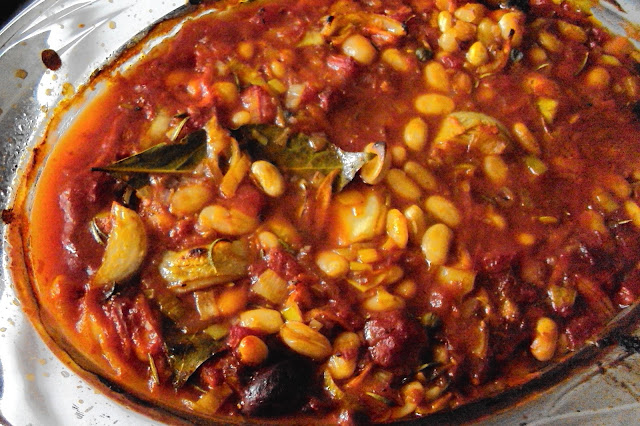
Take a deep, oven proof dish, and add the cooked beans to it. Add the cooked onions/leeks/shallots, and the remaining ingredients. Roughly chop/smush the tomatoes. Bruise/crush the bay leaves a little if they are fresh from the bush. Do not add salt at this stage, but you can add cracked pepper. Adding salt will make the beans harder and more difficult to cook. Add as much water as the container will fit (up to 400mL) and bake for at least 2 hours at 200ºC. Check the beans as they cook and add more water if they need it. Ideally, you won't add any more liquid in the last 45 minutes of cooking.


If you're pushed for time, the beans can be finished off in a large pot on the stove. I did this because it was getting on to 9pm and, despite 3 hours in the oven, the beans still weren't done. I didn't get a final picture as my camera is no good for photographing food once it's dark; but the final product was definitely more reduced than the picture above.

We ate the beans with toasted dark rye bread - made by a local guy who makes his own stone ground flour - and some simple greens from the garden. You could also have them with a poached/fried egg on top, or with homemade corn bread.

They are filling, and warming, and perfect for a pre-daylight saving's September Sunday night.

-----

title from the bats - spill the beans