more about us

Showing posts with label dinner. Show all posts

May 30, 2013

let's not try to figure out everything at once | baked polenta with tomato


There are many things in life you can't control. Sometimes I find it best to deal with these things by distracting myself - with work and cooking and people and food. This works for a while, and then there's a week where everything catches up with you.... I had that week last week. But even though there were many moments when I questioned my sanity or purpose - it all worked out in the end.

Now I'm feeling a little burned out, but looking forward to less chaotic June filled with winter dinners and lab work. As it would happen, the other morning we woke up to silence - true silence.. and a blanket of snow covering our hill and city. It's an unusual enough occurrence to spell a snow day for us - so we made porridge this morning and ate that in our pyjamas, before venturing the long way into town to look at the snow.
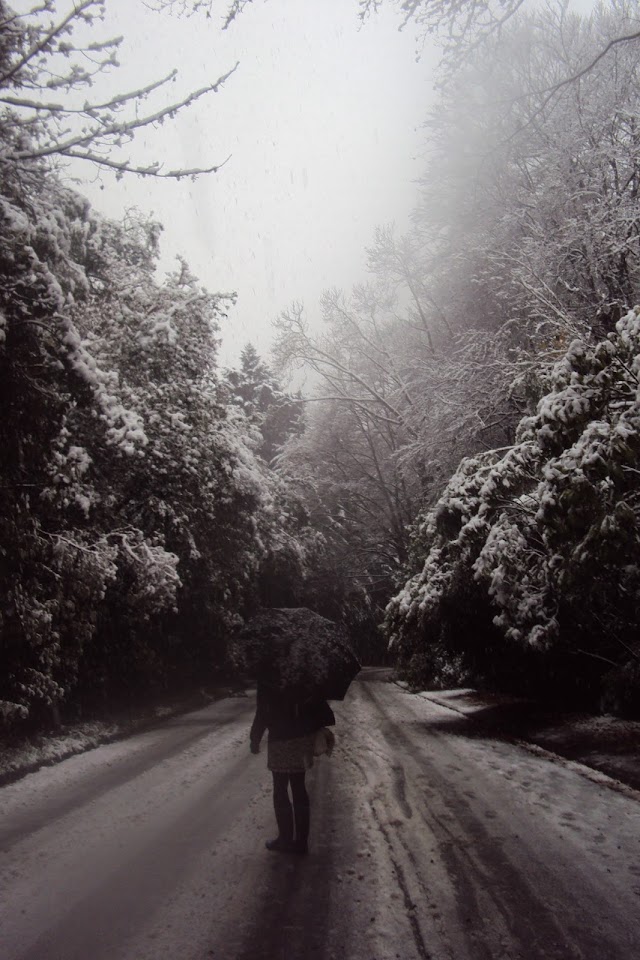


After a few slips and slides down the hill, I purchased a few more onions and made french onion soup to warm us up - I used red wine this time, as it was all we had, and it made a hearty, salty broth. It warmed us up - especially needed as that day the temperature didn't get over four degrees!

This time of year can be hard - it's dark when you have to get up, dark when you come home from work, difficult to get out of bed in the mornings, and there's still another month of the days getting shorter to get through before the solstice. Also, it can be cold - the kind of cold that settles in your bones and stays there all day; the kind of cold that requires thermals underneath your pyjamas and at least two hot water bottles ... the kind of cold that requires a hot, warm, easy to eat dinner.

This dish is perfect for those times where you feel a bit unnecessarily irritable, or flighty, or unsettled. When all of a sudden there's a wind through the house, slamming doors and making maracas out of the leaves. When there's so much to do you don't really want to spend time cooking but you don't have the money or inclination to go out. When it has been cold for a while and, despite loving soup, you're a bit tired of it. You can make it any time of year, it's gluten free, and you could easily make it to be dairy free too. It's hearty, filling, and simple to make.

baked polenta with tomato

You won't believe how little this recipe requires in terms of effort. It's inspired by this recipe with just a few changes.

2 cups coarse polenta/cornmeal
1.5 L water
1 tsp salt
50g butter
1 tsp chili flakes
1/2 cup grated, or about 50g cheese - any kind, the stronger the better! 

2 onions
3 cloves garlic
1 tsp cumin
1 can tomatoes (or fresh, if you've got them)
1 tsp chili flakes

bay leaf
optional - other grilled vegetables like aubergine, olives, mushrooms, courgette.. 

Pour the polenta into a large, oven-proof dish, large enough to contain 1.5 litres of water. Add the salt, and water, and stir until the water goes a bit cloudy. Bake at 180ºC for 45 minutes.

While the polenta is cooking, make the sauce. Lightly cook the onions, add the tomatoes and chopped garlic and spices, and let reduce for a while. If you have some red wine handy, you could add this in for a heartier flavour. Keep warm until the polenta is ready.


After 45 minutes, take the polenta out of the oven and stir through the butter, cheese and chilli flakes, and cracked pepper if you like. Return to the oven for another 15 minutes. It will be done when the top is dry, and the polenta doesn't wiggle too much. The polenta will hopefully be the consistency of a thick porridge, creamy and delicious.

To serve, spoon the sauce over the polenta. Eat with grilled vegetables if you like, and you can add extra cheese to the top if you so desire as well. Enjoy!

-----

I've been finding myself thinking lots of India recently - perhaps because I am in the process of finalising a different trip overseas - this one is a lot more unexpected and I am feeling very lucky to have the privilege of travel.


When I think of India at the moment, I think of sounds - a camel braying at a camel farm just outside of Bikaner. The hauntingly beautiful Muslim prayers broadcast into the desert air five times a day - the first thing I'd hear in the morning and the last thing I'd hear at night. The soft whumpf-whumpf of the pigeons that nested under the windows in the guest house we stayed at in Pushkar. The deep and sustained snoring of one of the most obnoxious men I've ever had the (questionable) privilege of sharing a sleeper car with. The chai-wallah's particularly unique way of offering their wares. The cracking sound of a stick on a dog's back. Horns, of all different timbres, usually all at once. The loveliest Japanese man playing ravanahatha so beautifully on the first morning of the New Year... so many sounds I'll always remember.

-----

title from the national - fake empire

April 2, 2013

i feel it in my bones | spiced beetroot & caramelised onions on bread


There's something special about coming home after going away. Today I returned to Maitland and tonight J followed suit. The kitchen is filled with gifts we've brought with us - spring onions from Mum's garden and lemons from the tree at Fitzroy St, organic leek seeds from the Hill St farmer's market my parents frequent, an old book of music with some familiar tunes for the piano, milk and quark from Merrell, wild thyme from somewhere around Cromwell, eggs from Moeraki. We're lucky and blessed here - and tonight I definitely feel appreciative of the people whom I always miss, in some way or another.


For Easter I flew back to Wellington, where I grew up, to see the family. Pictured above is Mum, Dad and I at the top of Brooklyn hill on Easter Sunday. Shortly after this photo was taken, the rain set in, and we returned home completely drenched (but happy). My brothers and sister still live in Wellington and it's hard sometimes to be the only sibling on a different island. Even though it's not that far when you think about distances in astronomical terms (although no distance on the Earth seems large when you think about exactly how great a distance one light year is...) I still miss them. In many ways, though, we're still close. My current favourite pair of jeans initially belonged to my brother A, my brother S recently visited, my sister E (pictured with me below) probably still has her hair in the French braid I did this morning at the airport for her. In my parents' fridge there's a jar of aubergine pickle and they're also enjoying roast apricot jam: both made at Maitland. 


Perhaps the highlight of my Easter weekend was when A came and cooked dinner, and S drove up the hill after the game at the stadium, and the lounge was filled with all six of us, just like it once was almost every night. And I guess even though Dunedin and Maitland are now my home, it's always so good to be just the six of us: whether it's in Wellington over Easter, in the Wairarapa over Christmas, or in fact, anywhere in the world. The place doesn't matter so much as seeing those other five familiar faces ...

You might have wondered where I've been. Just like life has its ups and downs, so does my cooking motivation. The past couple of weeks I've only just had the energy to make simple lentil curries or baked spaghetti squash (more difficult than it first appeared). However, perhaps due to watching a couple of Hugh's autumn at river cottage episodes over Easter, my inspiration has returned! Here's a recipe for what I made for dinner last night .. 

spiced beetroot & caramelised onion on bread

I thought very carefully about what to call this one. Technically, you could call it a "toasted sandwich" but those words together in my mind conjure up an image of spaghetti and cheese toasted sandwiches, a favourite of me and my siblings for those after school afternoon teas. There is no appetite like the after school appetite of a teenager!

It might seem like this is a bit fiddly, using multiple pans, but it's the perfect thing to make when you're really just moseying around on a Sunday evening/night, maybe put some emily king on, and really enjoy chopping and cooking and stirring ..

2 baby beetroot (or 1 medium-sized)
2 cloves garlic
1 tsp ground cumin
1 tsp mustard seeds
1 onion, red or brown
1/2 tsp honey
balsamic vinegar (about 1/3 cup, but I never measure this)
olive oil
butter or a high-heat oil, eg coconut
bread - if you're me, it will be something seedy
cheese - optional, but I used quark and also a bit of cheddar 
cherry tomatoes or 1 tomato
spring onion
thyme (optional)
1 lemon

The first job is to caramelise the onion. Chop the onion into fine half-rings and briefly sauté in a hot pan with a little oil or butter. When they've cooked for a couple of minutes, add the honey and balsamic vinegar. Cover, turn the heat down to medium, and cook for 20-40 minutes, stirring occasionally.

The next job is the beetroot. I didn't peel these, just removed the top and long roots, and grated them with a cheese grater. Heat a small amount of butter or coconut oil and add the mustard seeds and ground cumin. Chop the garlic finely, and add both the garlic and beetroot to the pan when the mustard seeds start making a popping noise. Cook for about 10 minutes on a medium heat.

Chop the tomatoes and spring onions into small pieces. Add chopped thyme if you've got it, and make a simple dressing with a bit of lemon juice and olive oil.

If you've got a sandwich press the next part will be simple. We don't, and it's not too difficult. Slice the bread, assemble, press down a little and then toast in a hot pan (I reused the caramelised onions pan) until golden on the outside. Slice, and then tip the tomatoes over the top.

-----


If you clicked on the emily king link above and enjoyed "georgia" - why not enjoy even more this version - made by some talented folk including one of my closest friends' talented brother who's been playing the piano in a remarkable way since pretty much forever. He's the one on the keyboard. 

-----

title from step - vampire weekend


December 10, 2012

the moment is now | bare-cupboard salad


I've been away and it's been fantastic. I travelled up the country over land by car, train, and ferry, and spent time along the way catching up with family and friends I haven't seen for a while. The final three days were spent in Auckland, attending Power Shift, a youth summit focussing on climate change and action we need to take. It was intense and inspiring, and I'm still processing my thoughts and ideas and plans ... There are many more things to say but I will save them for another day. The top picture shows the train we travelled on, passing by the coast in between Kaikoura and Blenheim in the South Island.

We (unfortunately) had to fly back last night - and after the scariest experience I've ever had on a plane caused a delay of a couple of hours, we got home close to midnight. The plane was halfway through taking off - accelerating down the runway - when the brakes were suddenly applied and the take off was aborted. After sitting in the plane while the pilots and engineers chatted, it was decided to change planes for our journey - much to everyone's relief.


When I got home this afternoon I realised I had completely forgotten to stop by Taste Nature on my way home. Our lovely friends had stopped by and left milk bottles in our fridge and a loaf of beautiful bread on our bench, as well as completely spring cleaning the kitchen, and leaving a worm farm by our front door! However, a worm farm won't help you produce vegetables in time for dinner ... but your garden will.


I felt much more inspired after collecting arugula, coriander, kale, chard and nasturtiums from the garden. I put some red and white quinoa on to boil and this simple, bare-cupboard salad was born.

bare-cupboard salad

1 cup quinoa
1 onion
a few leaves of chard
a few leaves of kale
arugula (or mesclun/spinach)
coriander
pumpkin seeds
raw nuts - I used peanuts
chia seeds (optional)
olive oil
balsamic vinegar
sea salt
cracked pepper


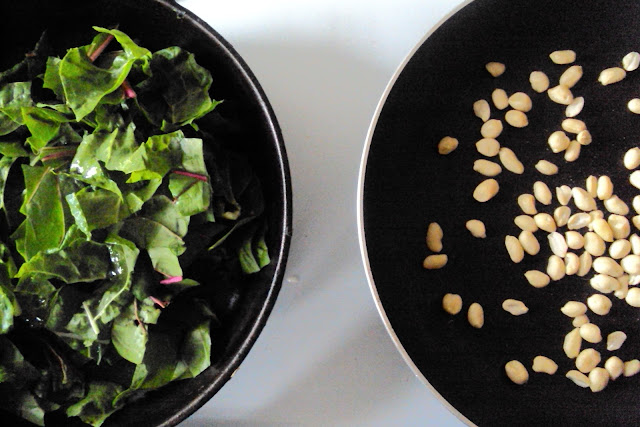
Wash the quinoa and put it on to boil with plenty of water. While this is cooking, chop the kale leaves into small pieces, avoiding the "ribs" (the stem/stalk part). Put the chopped kale in a bowl, add a little olive oil and a good amount of salt, and massage it with your fingers. It might sound strange, but massaging helps break down the fibre and starches in the kale that can make it quite bitter. You will notice that after about two minutes of massaging, the leaves are now softer, darker, and silkier. The amount will probably appear to halve in size too. Taste it - it tastes different now!


Slice the onion and chard and sauté these briefly. At the same time, dry roast the nuts and seeds. I just do this in a fry pan without adding oil. Make sure to move the nuts around a bit during this process, either by stirring or shaking the pan. You will know they are ready because the pumpkin seeds will start popping.


The quinoa will most likely be done by now - you'll see that the circles have popped open and released a little worm shape - this will make sense if you've cooked with quinoa before! Quinoa is such a versatile food - you can substitute it for rice or pasta - or you can eat it colder as in this recipe. It's good for you as it's a complete protein - meaning it contains all nine essential amino acids. An essential amino acid is one that cannot be synthesised by our bodies, so it's important to ensure our diets contain adequate amounts of these amino acids.


Drain the quinoa and rinse cold water through it to end the cooking process. Assemble all the previously prepared ingredients together, mix to distribute evenly. Chop the coriander and add this too. I made a simple dressing for this with equal amounts of balsamic vinegar and olive oil and a little salt and pepper - but as I made a much larger salad to take for lunch tomorrow, I kept this on the side.


I ate this with a plain piece of toast - and I felt pretty pleased I managed to pull this together from a rather bare cupboard, and motivate my tired body to make some dinner when it was just me at home.  If you needed a reason to start a vegetable garden, hopefully this post will help convince you! Our garden is currently producing so much coriander - it always amazes me at what a transformation it is, big tall plants from tiny, delicate seedlings we planted two months ago. Our neighbours left/gifted their blender to us while we were away so I think that pesto might be in order .. 

-----

day 5/365
today I'm grateful for inspiring individuals and the chance to connect with passionate people over the weekend. A quote from the weekend "we are unstoppable: another world is possible." - which ties in nicely with the 100% possible campaign that was just launched - check it out! 

-----

title from macklemore ft ryan lewis - ten thousand hours (love the malcolm gladwell mention)

November 22, 2012

so tomorrow there will be another number | meat and three veg


After this lovely lady's post, I've been thinking about food choices a lot more this week: thinking about my own personal journey to the way I eat now, and how those habits developed over time. My food journey began last year - six months into my first "proper" job since finishing my degree, I found myself with a little extra money each week and the ability to be a little more flexible in what I ate. After four years as a student surviving off a very minimal weekly income it was a luxury to be able to afford to experiment a little more in what I cooked and what I ate. 

Prior to this, my food choices had been based around affordability: sometimes this meant two baked potatoes or two minute noodles for dinner in those weeks where there were bills to pay and shampoo to buy. At the end of my fourth year, busy with writing a dissertation, this changed a little to include time as a factor. Could I cook and eat in less than 20 minutes? If not, I didn't buy it. In those last two weeks of 18 hour writing days, I survived off plain pasta, canned tuna, apples, and a whole lot of caffeine. On the last night before my dissertation was due, I was writing all night in my office at university. A friend called me at 7pm: "I'm outside," he said, "come down, I've got dinner for you." And he handed me a warm plastic container full of pesto pasta, before skating back off into the night. I've never forgotten that gesture. 

Most of my friends and family know me to be a vegetarian. And that's mainly true - I only rarely eat meat, and when I do, it's important to me that it is local, free range, and organic; and that I feel like my body needs it for nutrients. This year, I've eaten meat on two occasions. The first was when there was no other option for dinner, out in the wilderness with family. The second was last night.

J returned from four days tramping (hiking for US readers) with plenty of stories of interesting people they'd shared a hut with. They had met some hunters who cooked freshly caught chamois (also known as "shammy" to locals), and also gave them some to bring back home to us. It ticked all my personal "boxes" when it comes to meat-eating and when J told me she planned to cook it for dinner on Tuesday night, I told her I'd love to try some. I'd never eaten chamois before. I made this sauce to go with it - I think it would make a great accompaniment to lamb or beef as well.


mushroom & black pepper meat sauce

This meat sauce would also be great served with pasta for a vegetarian dish. The quantities used here make enough for four people.

Slice two red onions into half rings, and soften them over a medium heat with a little olive oil. Turn the heat up a little and add some apple cider vinegar and honey or balsamic vinegar. Cook for around 30 minutes until caramelised. Add about 1 glass of red cooking wine to the pan - it should bubble a lot, if it doesn't turn the heat up. Chop 8 flat mushrooms (I used portobello) into quarters and add to the pan, letting them cook in the wine. Stir in as much freshly cracked black pepper as you'd like. Turn the heat down to medium-low. Add 1 tbsp flour - either white or wholemeal and stir. This will thicken the sauce up - add milk to thin it back and keep warm until ready to serve.

Last night I cheated a little - we had some french onion soup to use up, so I used that instead of caramelising onions. 

So it came to be - a traditional "meat and three veg" meal was served at Maitland St. The cooking was very much a team effort, with much discussion and consulting the internet as to how to cook the meat. The piece we were given looked like a beef fillet would, so we sliced it into medallions and cooked it, as T would describe "pshhhh....pshhhh..." - translates to one minute each side in a very hot pan. We ate it with the mushroom sauce, potato and kumara (known outside of Aotearoa as sweet potato), mashed together, and lightly fried cabbage and red onion. It was delicious.


I think the biggest mistake we can make is to be inflexible in our diets. I realised that it's important to me to eat mainly vegetarian, but that it's also okay for me to eat free-range, organic, local meat now and then too. After all, isn't it all about moderation?

-----

I've decided that each day I write a post I'm going to include a word or two about something I'm grateful for that day. I used to reflect once a week and take the time to be grateful, and I think that it's helpful for me to look back over my day with gratitude now and then.

day 1/365 
Today I'm grateful for clear and cloudless skies, and that I work in a place where I can take twenty minutes in the afternoon and sit underneath a weeping willow tree, looking at water and the old fashioned clock tower buildings of the university I work at, enjoying the fresh air in my lungs and sun on my skin.

-----

title from stars - celebration guns

November 21, 2012

l'espoir fleurit au ciel de Paris | french onion soup

More so than perhaps any other year, I'm feeling the year race away from me. In the coming weeks I'm travelling to the other end of the country and back, twice, as well as a flying visit to my grandparents this weekend to celebrate a significant birthday. There are end of year dinners, work social occasions, a youth conference/festival on climate change, a brief stop in my home town, two more weeks of work down South, Christmas with the family, and I'll end up at the northernmost tip of the North Island to say goodbye to 2012. Phew!

While it is nice to have plenty of social occasions and dinners out, it's also nice to make the most of a simple dinner at home, cooked in the light and eaten in the light. Evenings stretch out at this time of year, when it's still light at 9pm, and I love waking up early to the sun coming in my open window. I almost always sleep with my window open, only closing it for the iciest winter nights. Mum tells me this is something I inherited from my dad.

Come Monday afternoon, I had a strong craving for french onion soup. As a meal, it seems to be a compromise between seasons - light but hearty, warming and delicious but not too heavy either. I left work and purchased onions on my way home. As I cooked in the late afternoon light, the grey shower clouds parted briefly and sunlight came streaming through our kitchen windows. Soup was cooking and the sun was shining and all was right with the world. 


french onion soup | soupe à l'oignon

The French have a certain culinary class like no other. It takes a certain je ne sais quoi to make a soup consisting almost solely of one of the most common vegetables, and legitimately call it cuisine. But it is deliciously good, even when you replace the traditionally used beef consommé with a homemade vegetable stock. Don't let that put you off: you will hardly even notice the extra effort to make vegetable stock from scratch!

for the soup:
10 medium sized white onions
50 grams butter (or oil to make this recipe vegan)
a good cup of dry white wine
a sprig of flat leaf parsley
a sprig of aromatic fennel
a sprig of sage
2 bay leaves
brown miso paste
sea salt
cracked pepper

for the stock:
a variety of left-over vegetable pieces: cabbage hearts, the thick cauliflower stems, broccoli stalks if you don't eat them, the green leafy part of a leek.. We keep these left overs in the fridge for stock purposes!
3 garlic cloves
sprig of parsley
bay leaves
1 medium onion
4-5 mushrooms, preferably a flat, dark type such as portobello.

to serve
two pieces of good, solid bread per person
a little olive oil
3 garlic cloves
cheddar cheese

Begin by making the stock. Add all the vegetables to a big pot, cover with water and gently simmer. If I'm making stock for other purposes I sometimes add a little sea salt, but it's not necessary for this soup. I don't always make stock with mushrooms either, but for french onion soup the hearty taste they add is a delicious addition - although it's still pretty delicious without mushrooms. Keep this heated on low while you caramelise the onions.

Slice the onions en lyonnaise - which is, as shown below, sliced in half and then north to south slicing down the axis, so you end up with little onion crescent moons. It doesn't take long once you get in the rhythm of it, promise! 


Melt the butter in a heavy frypan - I used a cast iron one - over a medium heat. Let it sizzle a little. I used some raw butter we had and it smelled delicious - when it begins to smell nutty, it's time to add the onions. Add the onions in layers and sprinkle a little salt on between each layer. We don't add any salt later: salt at this point draws the moisture out of the onions so they caramelise in their own juices. 


Let the onions bubble away for a good 20 minutes before stirring them. They will release a lot of liquid - this is a good thing! This cooking process is "sweating" the onions, not sautéeing them. If they are sizzling too much, turn the heat down until they just bubble. They will most likely catch on the bottom of the pan, but this is ok. Cook for a further 40 minutes, stirring every 5 minutes or so, until the onions are a golden brown colour. Don't be tempted to cut this step short - the flavours that are developing here are integral to the soup, and you'll regret it if you end up with a light onion-y broth.


Strain the vegetable stock and return it to the pot. Turn up the heat on the onions and add the dry white wine. It will sizzle and steam a lot, and probably turn a dark brown colour. This is excellent! Stir for about five minutes, then add all the onions to the stock and heat. At this stage, add the fresh herbs. If you like, you can tie them together with some string to make a bouquet garni, which means it is easier to remove before serving. This is when you also add the brown miso paste. If you don't have miso paste to hand, you could use vegemite/marmite instead.


While the soup bubbles away on the stove, slice up some good solid bread. I've used our bought homemade bread - it's a wholemeal/rye blend made by a local who stone grinds his own flour. It's delicious but good and substantial too. Smush the garlic cloves to a paste in a mortar and pestle - add a little olive oil to them. Mix the ground coriander in too. Rub this paste over both sides of the bread, then toast under a hot grill for 2 minutes. Turn over, add sliced cheddar to the top, and return to the oven for another 2 minutes.


To serve, fill a bowl with the soup, avoiding the herbs, then float the toasted bread and cheese on top. The bread should be crunchy enough to withstand soaking up some of the soup. Eat immediately. It's amazing how filling this is - a friend told me that the best french onion soups have enough bread so that there is a bit of bread for every mouthful of soup. It's warming, filling and amazingly delicious considering it's just made with onions, wine, and herbs.

-----

title from Édith Piaf (who else?) - sous le ciel de Paris. The translation of the lyrics used in the title is "Hope springs again under the Paris sky."

October 8, 2012

you'd be the first to know | homemade baked beans

beach dunedin


September is the beginning of spring - at least, that's what the calendar says, so that's what everyone hopes. But September is a strange month, where gorgeous spring days and daffodils in flower are punctuated by icy reminders that winter isn't over just yet; to keep the tights handy and the woollen coats on the nail by the front door.

It's a strange month for meals. On the one hand, daffodils and asparagus are a welcome addition to items available for purchasing, the garden goes crazy growing its greens, begging you to make salads and pesto (if you're lucky enough to have a food processor). On the other hand, the cold weather, made all the more difficult to bear by the teasingly warm spring days in between, makes you feel like hearty soups, spicy curries, beans.

I think that beans are so underrated. They are an excellent and healthy source of protein, and they're so versatile. You can boil them with star anise and cassia bark and eat them for breakfast with avocado, brown rice and canned chopped tomatoes; you can make a bean salad, you can spice them up with chili and eat them in wraps with cumin yoghurt and grated carrot ..

.. and you can make homemade baked beans. 

I have fond memories of school holiday lunches with my primary school teacher dad, who also had the same holidays as us. We relished the break from the monotonous peanut butter sandwiches and almost always had a hot lunch - curried eggs, omelettes, bird's nests, toasted sandwiches, Wattie's baked beans on toast. Simple and cheap, but filling lunches I would gratefully remember and make for dinners as a poor student. There's always a time and a place for canned spaghetti or baked beans (but only if it's Wattie's brand).

However, if you've got an ever so slightly larger budget, a little time on your hands and beans in your cupboard; making them from scratch is incomparably delicious. It takes time - but you'll be rewarded with a delicious pile of baked beans and a wonderfully aromatic house. The beans are even better the next day or the day after - so this is an ideal recipe to make on a lazy Sunday afternoon and enjoy baked beans for lunch at work in the coming week. After all, the time is mostly cooking time! 

baked navy beans

Navy beans/haricot beans are white and large, similar to cannellini beans, which you could also use. Any white bean will do. I wouldn't use the canned counterpart for this recipe. An important note on cooking - cannellini beans are related to (red) kidney beans, and as a result have high levels of lectin, a toxin. This toxin can be denatured (deactivated) by ensuring that you boil the beans hard for at least 10 minutes - never cook beans in a slow cooker, as the slower cooking and lower temperatures mean that the toxin might not be denatured. 

2 cups navy beans, presoaked overnight.
2 cans whole peeled tomatoes (ever since I reading Hugh Fearnley-Whittingstall's book veg everyday, where he says that he feels he gets more value for money buying whole canned tomatoes as opposed to the chopped variety, I've been following suit!)
2 tbsp balsamic vinegar
1 tbsp tamari (or worcestershire sauce, or 1tsp brown miso paste, or 1tsp vegemite)
rosemary
2 bay leaves
8 cloves of garlic, cut into pieces
25g butter (can be substituted for a high-heat oil like canola to keep this dairy-free).
2 onions, chopped finely
1 leek, chopped finely
6 shallots, chopped finely
1 red onion, cut into wedges
1 tsp cumin
1 tsp English mustard
handful of good olives - we use a brand which is the best, according to a friend who devours olives. They are not pitted. Definitely don't use the stuffed green ones (shudder) or the tasteless chopped black ones. They're not essential so if you don't have any good ones, just leave them out.
1 tbsp capers


Put the dry beans in a large bowl and cover with plenty of water. Leave to soak overnight, for at least 12 hours. Soaking the beans makes them quicker to cook and easier to digest. Overnight they will at least double in size. The picture below shows the beans after they have been soaking for 48 hours. I apologise for the picture, my camera does not have very good capabilities in low, grey light.

navy beans


The next day, drain and rinse your soaked beans. Put them in a pan with fresh water and bring to the boil. Boil hard for 30 minutes. If foam forms on the top of the water, scoop it off and throw it away. After 30 minutes (they won't be fully cooked yet), take them off the heat, drain and set aside.

While the beans are boiling, heat the butter in a heavy bottomed pan (we use a cast iron fry pan).  Add  the cumin to the butter. Gently sweat the finely chopped onions, leek and shallots in the cumin/butter mixture. This will take around 10 minutes.

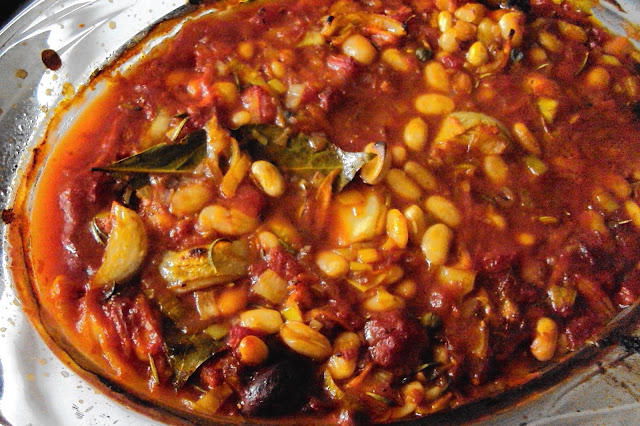
Take a deep, oven proof dish, and add the cooked beans to it. Add the cooked onions/leeks/shallots, and the remaining ingredients. Roughly chop/smush the tomatoes. Bruise/crush the bay leaves a little if they are fresh from the bush. Do not add salt at this stage, but you can add cracked pepper. Adding salt will make the beans harder and more difficult to cook. Add as much water as the container will fit (up to 400mL) and bake for at least 2 hours at 200ºC. Check the beans as they cook and add more water if they need it. Ideally, you won't add any more liquid in the last 45 minutes of cooking.


If you're pushed for time, the beans can be finished off in a large pot on the stove. I did this because it was getting on to 9pm and, despite 3 hours in the oven, the beans still weren't done. I didn't get a final picture as my camera is no good for photographing food once it's dark; but the final product was definitely more reduced than the picture above.

We ate the beans with toasted dark rye bread - made by a local guy who makes his own stone ground flour - and some simple greens from the garden. You could also have them with a poached/fried egg on top, or with homemade corn bread.

They are filling, and warming, and perfect for a pre-daylight saving's September Sunday night.

-----

title from the bats - spill the beans